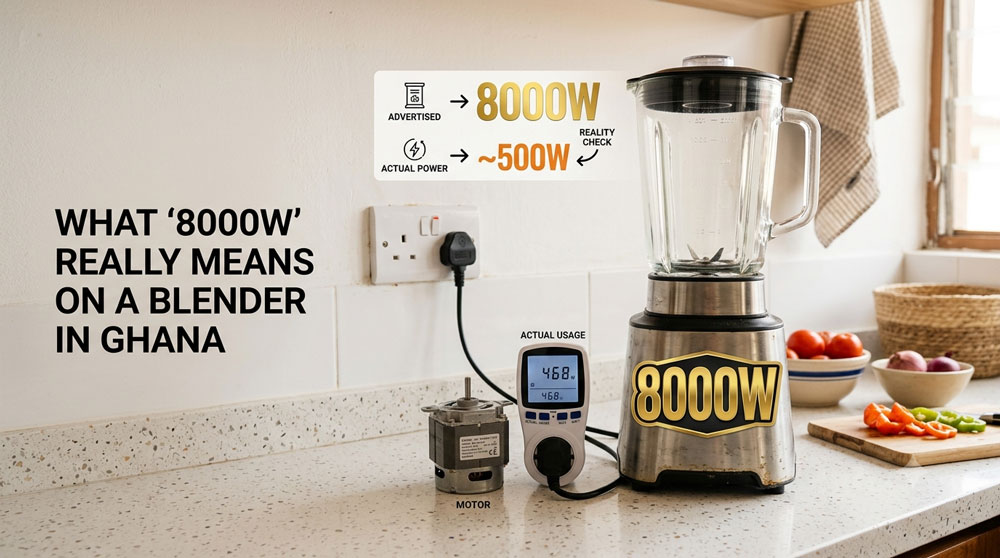
Quick answer. No blender plugged into a Ghanaian wall socket can draw 8000W, or 4500W. A Type G socket delivers at most 2,990W and a Type D at most 1,380W. The number on the box is a peak marketing figure. Real continuous draw on a typical 2L commercial blender is around 600W, which costs about GHS 6.11 a month to run.
The arithmetic anyone can check
Ghana’s mains supply is 230 volts. Power is volts multiplied by amps. The two domestic socket types set a hard ceiling:
| Socket | Rated amps | Maximum deliverable power |
|---|---|---|
| Type G (the rectangular three pin) | 13A | 230 x 13 = 2,990W |
| Type D (the round three pin) | 6A | 230 x 6 = 1,380W |
An 8000W load would need 34.8 amps, which is 2.7 times what a Type G socket can supply and 5.8 times a Type D. The fuse in the plug blows long before the motor ever sees that power. A 4500W claim needs 19.6 amps and fails the same test.
So why is the number on the box?
It is a peak or stall figure: the instantaneous surge at motor startup, or the theoretical maximum the windings could momentarily survive. It is not what the motor draws while blending your pepper. The same trick inflates horsepower claims on premium blender brands worldwide. One horsepower is 746 watts, so treat these labels as marketing units rather than electrical ones.
What it actually costs you to run
At the PURC residential rate of GHS 2.04 per kWh, effective 1 July 2026, ten minutes of blending a day comes to:
| Real continuous draw | kWh per month | Cost per month |
|---|---|---|
| 300W | 1.5 | GHS 3.06 |
| 600W (typical 2L commercial) | 3.0 | GHS 6.11 |
| 800W | 4.0 | GHS 8.15 |
| 1200W | 6.0 | GHS 12.23 |
Here is the part that should change how you shop: the blender, the appliance with the scariest number on the box, is one of the cheapest things in your kitchen to run. The quiet ones are the expensive ones. A double burner hot plate at typical use costs about GHS 91.69 a month.
What to look at instead of the wattage
Jar size for your family, whether it comes with a genuine dry mill if you grind grains and spices, blade metal, and whether the seller holds local stock so a warranty claim has somewhere to go. Every blender we sell states its realistic draw class, its running cost at the current tariff, and its price verified for the current month.
Sources and working: PURC Q2 2026 tariff decision plus the 3.49 per cent increase effective 1 July 2026; Ghana mains 230V; socket ratings per the Type G (13A) and Type D (6A) standards. Cost formula: watts / 1000 x hours per day x 30 x rate.
